An oven that bakes long is a measurement problem
The most common complaint we take on ovens is not a broken part. It is “everything
takes longer than the recipe says”, and the display insists the oven is at 350.
Displays report the set point, not the cavity. A temperature sensor that has drifted
will feed the control a reading that is optimistic by 20 or 30 degrees, and the
control will happily hold the oven there. Everything bakes long, cakes sink, and
roasting times stop making sense.
So we measure. An independent probe goes in the cavity, and we log the actual
temperature across a full preheat and a full cycle — the overshoot, the recovery,
and the average once it settles. Only then does anyone decide whether the fault is
a drifted sensor, a lost calibration, a failing element or a control problem. It is
the difference between a corrected offset and an unnecessary part.
Ignition faults and humid air
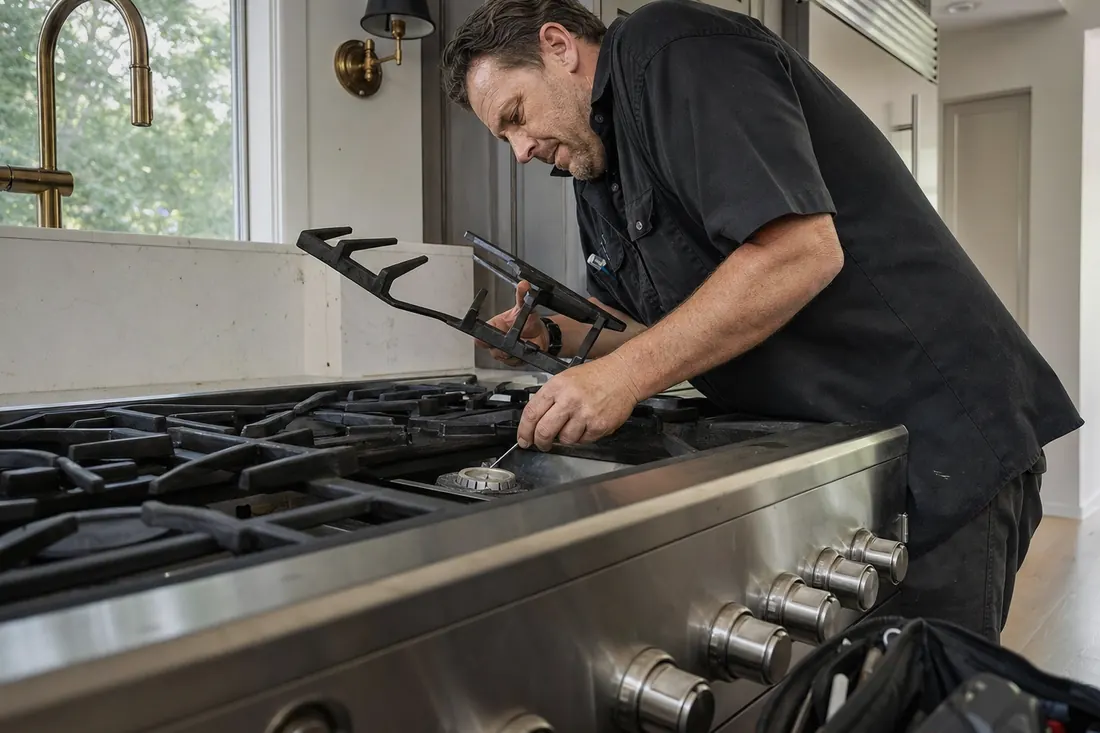
Gas ranges here develop a specific seasonal complaint: a burner that clicks and
clicks without lighting, or that keeps sparking after the flame is established, or
that fires every igniter on the range at once.
That is almost always moisture and residue on the electrode rather than a failed
spark module. Boil-over leaves a film, and at 75 percent mean relative humidity that
film does not dry between uses. The spark tracks to ground through it. Cleaning and
thoroughly drying the electrode and its ceramic collar clears most of these calls
without a part.
A yellow, lazy flame is a different fault: an obstructed burner port, a fouled
burner cap, or an air-shutter or gas-pressure issue. We check manifold pressure with
a manometer rather than judging the flame by eye.
Storm season is oven season, unexpectedly
Homeowners connect refrigeration to hurricanes and never connect ovens. They should.
Matthew took power from nearly 250,000 metro customers in October 2016; Helene took
113,000 JEA customers off the grid in September 2024. When a whole neighbourhood is
re-energised at once, the transient reaches every circuit in the house, including
the 240-volt range circuit and the wall oven.
Ovens rarely die outright. They fail selectively — the broil element stops, the
convection motor stops responding, the display loses a segment, the meat probe
circuit reads nonsense, or the oven runs but ignores the timer. If the fault dates
from the morning the power came back, tell us, because it changes what we test
first.
Steam and combination ovens
A steam or combination oven is two appliances sharing a cavity, and the steam half is
the half that generates service calls. It boils water in a generator, injects it into
a sealed cavity, and then has to get the moisture back out at the end of the cycle.
Each of those stages has its own failure: a generator that no longer heats, level
probes that misread and either flood or run dry, a solenoid that will not open, or a
drain and vent path that leaves the cavity wet.
The installation matters more than on a conventional oven. Some models are plumbed to
a supply and a drain, some run from a reservoir the owner fills, and the two are
serviced differently — a plumbed unit brings the supply line, the shut-off and the
drain routing into the diagnosis, while a reservoir unit brings the tank seals and
the level sensing. Knowing which one you have before we arrive changes what rides on
the van.
The cavity seal is the other pressure point. Steam only works in a cavity that holds
it, so a door that has dropped out of square, a gasket that has taken a set, or a
hinge that no longer pulls the door home shows up as poor results and moisture
escaping into the cabinetry around the oven — which, over a season, is a cabinet
problem as well as an appliance one.
Older kitchens, smaller openings
Through Riverside, Avondale, Old Ortega, San Marco and Old Mandarin the housing
stock is early twentieth century, and the kitchens have been retrofitted more than
once. Cabinet openings are undersized for current appliance dimensions, dedicated
circuits are often missing, and ventilation was added late. When a replacement is
genuinely the right call in one of those houses, the cabinet opening decides what
will physically fit — and that is worth knowing before anything is ordered.
What a visit includes
Cavity temperature logged with an independent probe, element resistance and draw,
sensor resistance, door alignment and seal condition, ignition and manifold pressure
on gas, and the control board’s actual behaviour under load.
$80 flat diagnostic, credited toward the repair when you approve it, written
estimate before any part is ordered, genuine OEM parts, 90 days on labor and 365
days on parts.