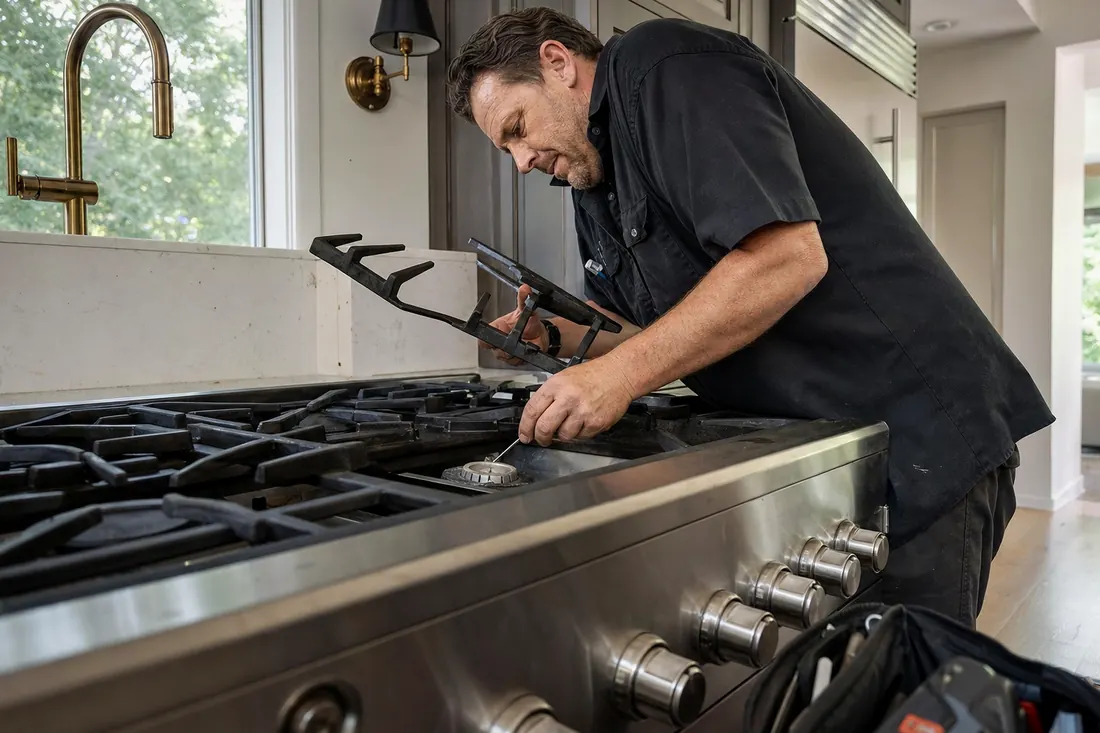
Cooking equipment, and only cooking equipment
Wolf makes ranges, rangetops, wall ovens, cooktops, ventilation, warming drawers,
microwaves, convection steam ovens and coffee systems. It does not make
refrigerators and it does not make dishwashers. If the Wolf in your kitchen is not
working, the fault sits in one of that appliance’s own circuits — the bake or
broil element, the ignition, the control, or the airflow through the cavity or
the hood — and that is where we start.
Most Northeast Florida kitchens we visit run one of three configurations: a
freestanding or dual-fuel range, a rangetop over a pair of wall ovens, or an
induction or gas cooktop with a separate oven column. The failure patterns differ
enough that the configuration is the first thing we ask about on the phone.
What the climate actually does to a Wolf
Cooking equipment is not obviously weather-sensitive, and homeowners are often
surprised when we tie a fault back to the season. Three mechanisms account for most
of it.
Sparking that will not stop. A sealed burner that clicks endlessly is almost
always a moisture problem before it is an electrical one. Spillover, a humid room
and a slow-drying igniter electrode leave a conductive film that keeps the spark
module firing on every burner at once. In a house running 75 percent relative
humidity outdoors and a kitchen that gets steamy the moment a pot boils, the film
does not dry out on its own between uses. Cleaning and drying the electrode and its
ceramic collar resolves a good share of these calls without a part.
Grid transients. Northeast Florida averages about 68 thunderstorm days a year.
A dual-fuel range carries a real electronic control board, and the convection oven,
the meat probe circuit and the display all depend on it. Boards rarely die
spectacularly; they die selectively. One element stops working, the display drops a
segment, the oven holds 25 degrees low, or the unit boots but ignores the bake
command. If a fault appeared the morning after a storm, say so — it changes what we
test first.
Heat soak and door seals. A sagging oven door or a compressed door seal lets
cavity heat spill up across the control panel every time the oven runs. Over a
couple of Florida summers, when ambient kitchen temperatures are already high, that
cooks the components behind the panel. A door that no longer closes flush is not a
cosmetic problem — it is the leading indicator for the board failure that follows.
Ventilation is part of the job
Wolf hoods and downdrafts get ignored until the kitchen starts smelling like last
week. In a humid climate, ventilation earns its keep twice: it removes cooking
grease and it removes water vapour that would otherwise settle on cabinet faces and
into the refrigerator’s door seam three feet away. A blower wheel loaded with
congealed grease loses airflow gradually, so nobody notices until the capture is
gone entirely. Baffle filters run through the dishwasher on a monthly cycle keep
that from happening; a loaded wheel needs pulling and cleaning.
Calibration is a real repair
The single most common thing we correct on Wolf ovens is not a broken part at all.
An oven that bakes long, browns unevenly or reads correct on the display while
sitting well below the set point usually needs its temperature sensor checked and
its offset re-established. We measure the cavity with an independent probe through
a full cycle rather than trusting the display. If the sensor has drifted, it gets
replaced; if the calibration has slipped, it gets corrected. Either way, you get the
measured numbers, not an opinion.
How we work on them
Every visit begins with an $80 flat diagnostic, credited toward the repair when you
approve the work, and a written estimate before anything is ordered. We fit genuine
OEM parts, and the work carries 90 days on labor and 365 days on parts. Gas work is
done with the meter and the manometer, not by feel.