Ventilation does a second job in a humid climate
In a dry climate a range hood removes smoke and grease. In Northeast Florida, where
the annual mean relative humidity is about 75 percent and the region takes roughly
53 inches of rain a year, it also removes water vapour that the room cannot absorb.
That second job is invisible until it stops. When a hood loses capture, moisture
from cooking goes somewhere: onto cabinet faces, into the ceiling above the
cooktop, and onto the coldest nearby surface — which in most kitchens is the
refrigerator door and its gasket. We have traced more than one gasket mould
complaint back to a hood that had not moved air properly in two years.
How a blower actually loses capture
The motor is rarely the problem, and homeowners nearly always suspect it first.
Loaded filters. Baffle and mesh filters are the first stage of grease capture,
and they load steadily. Airflow falls off gradually enough that nobody notices the
day it stops working. Monthly through the dishwasher solves it.
A greasy blower wheel. What gets past the filters lands on the wheel. Congealed
grease adds mass unevenly, the wheel goes out of balance, it moves less air, and it
gets louder while doing less. This is the classic “loud but not pulling” complaint,
and the fix is pulling and cleaning the wheel, not a motor.
The duct and the termination. A long or convoluted duct run, a crushed flexible
section, or an exterior damper stuck shut with paint or a wasp nest all produce
identical symptoms to a failing blower. On coastal ZIPs — 32082, 32250, 32266, 32233
and 32084 — exterior dampers also seize from salt corrosion. We check the
termination from outside as part of the diagnosis.
Downdrafts. A downdraft has a lift mechanism as well as a blower. Slow, sticky
or partial travel is usually the lift rack and its guides needing cleaning and
lubrication rather than a motor or control fault.
Induction cut-outs are thermal, not electrical
An induction element that works fine at medium power and shuts itself down after
several minutes at high power is almost always doing exactly what it was designed to
do. The electronics under the glass are cooled by a fan drawing room air, usually
through an intake in the cabinet or the toe kick. In a Florida kitchen that air is
warm and it carries dust.
Restricted intake, warm ambient, high sustained power: the module reaches its
thermal limit and backs off to protect itself. Clearing the intake path and the
cabinet around it is a genuine repair. Replacing a perfectly good generator module
because the fault was misread is not.
If an element fails cold — no response at all, or a fault indication from the moment
it is switched on — that is a different diagnosis, and it involves the coil, the
generator and the user interface.
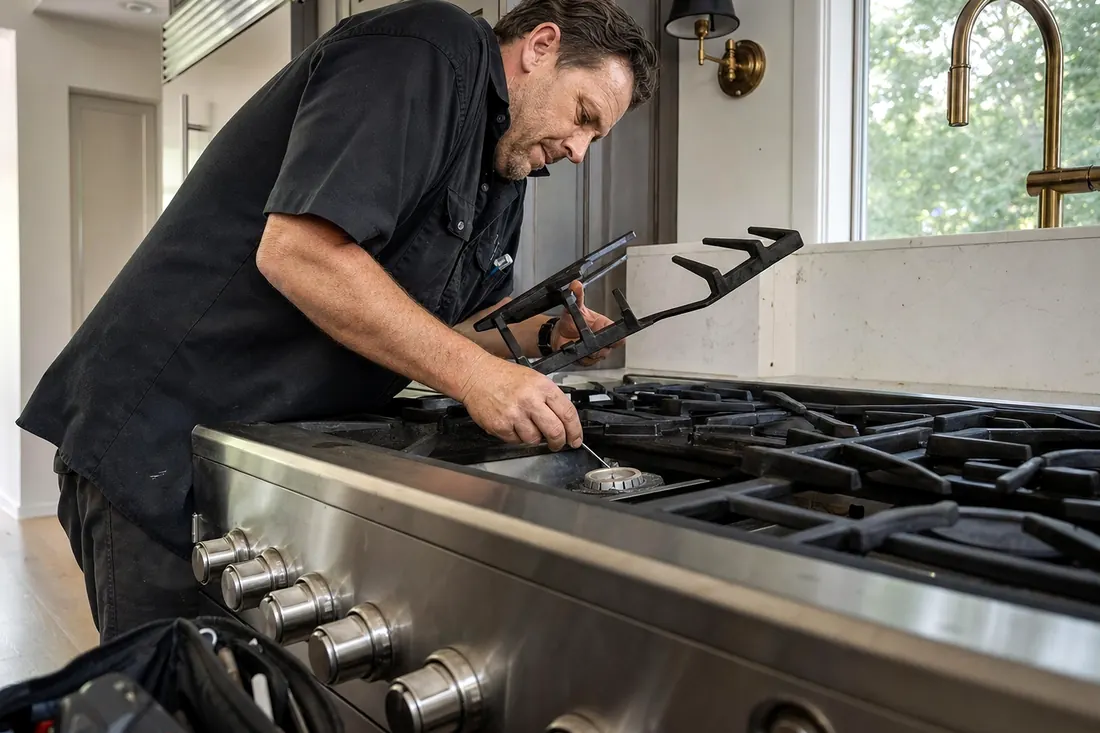
Gas cooktops and damp air
The seasonal complaint on gas is a burner that clicks and will not light, or that
keeps sparking after ignition, or that sets every igniter on the cooktop going at
once. Boil-over residue plus humid air leaves a conductive film on the electrode
that never fully dries between uses, and the spark tracks through it.
Cleaning and drying the electrode and its ceramic insulator resolves most of these
without a part. A yellow or sooty flame is separate — that is a fouled port, a
misseated cap, or an air and pressure problem, and we check manifold pressure with a
manometer rather than judging by the colour alone.
What a visit includes
Airflow and capture assessed at the pan, filters and blower wheel inspected, duct
run and exterior termination checked, induction cooling path and thermal behaviour
tested under sustained load, ignition and manifold pressure measured on gas.
$80 flat diagnostic, credited toward the repair on approval, written estimate
before any part is ordered, genuine OEM parts, 90 days on labor, 365 days on parts.