Thunderstorm season and appliance control boards — what is the short version?
Boards rarely die outright from a storm. They die selectively, one function at a time, which is why the fault reads as random.
Independent · Multi-brand
Northeast Florida
Mon–Fri 8–6 · Sat 9–4
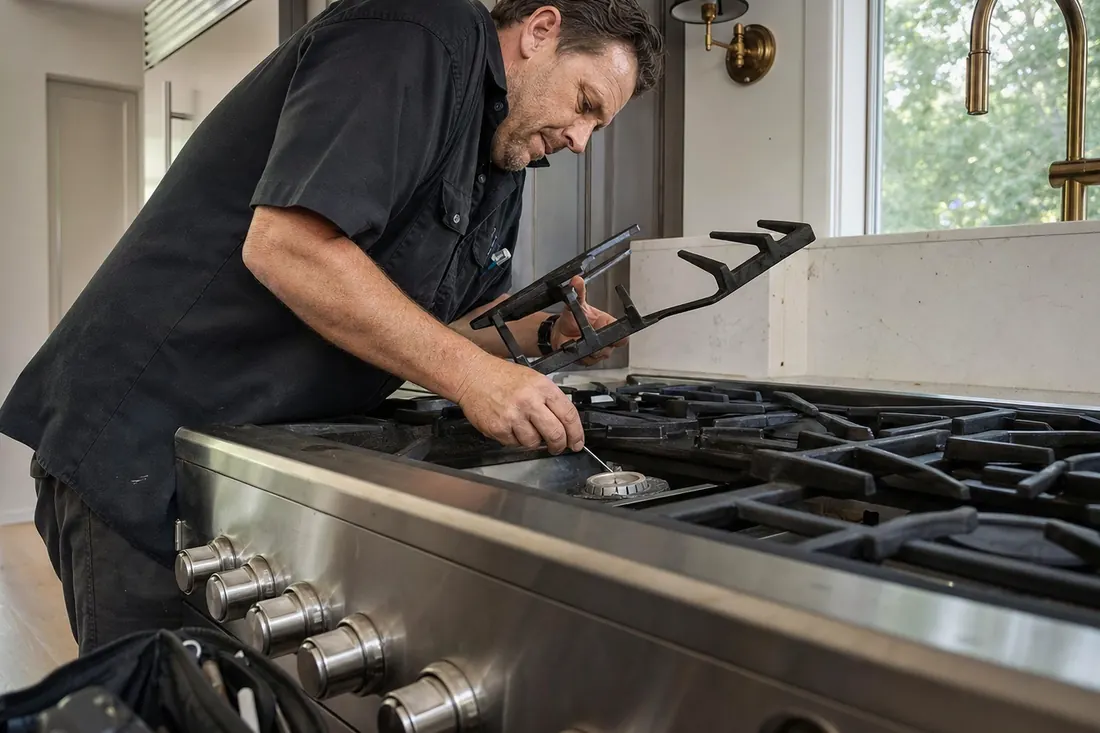
Walk the kitchen and note which appliances show a clock or a standby light. Anything with a display lit while it is not in use has a logic board energised at all times, and that is the population at risk. Talk to an electrician about a whole-house surge protective device at the panel — it is the one measure that covers hardwired 240-volt appliances a plug-in strip cannot reach.
A summer thunderstorm rarely takes power for hours. It takes it for two seconds, three times, while a recloser out on the line does its job. Each of those is a de-energise and re-energise cycle on every board in the house. If a storm is directly overhead and you are not cooking, opening the breaker on a range or wall oven costs you nothing for twenty minutes.
Do not wait to discover a fault at dinner time. Run the oven empty on bake for half an hour, run a short dishwasher cycle, and check that the ice machine is producing. Selective failures are the pattern: one element dead, a missing display segment, convection ignoring the command, a cycle that will not advance. Note exactly what is wrong before you call — it changes what we test first.
Northeast Florida averages roughly 68 thunderstorm days a year. That is not the same as 68 damaging events, but it is 68 days on which the distribution system in your neighbourhood is being interrupted, cleared and re-energised, often several times in an afternoon.
Hurricanes get the attention because the outages are long and the damage is visible. Summer thunderstorms do more cumulative harm to appliance electronics precisely because nobody counts them.
When a fault occurs on a distribution line — a branch, a lightning strike to the conductor, an animal across a bushing — a protective device opens the circuit, waits, and closes it again to see whether the fault has cleared. If it has, the lights blink and you get on with your evening. If it has not, it repeats.
From the appliance’s point of view, each blink is a full loss and restoration of supply, including the inrush when it returns. Do that a few times an afternoon, 68 afternoons a year, for a decade, and the components on a control board age in a way their designers did not have to plan for.
Direct lightning damage happens too, but it is much rarer than people assume, and it is not necessary to explain the failures we see. The ordinary switching is enough.
A control board is not a single thing. It is a power supply section, a set of relays or triacs driving loads, a microcontroller and its logic, and a user interface, all on one assembly. Different sections have different weak points.
That is why storm-related failures present as partial rather than total:
Homeowners describe these as “acting weird”, and weird is diagnostically useful. A partial failure after a stormy week points at the board and not at the mechanical part the symptom seems to implicate.
A whole-house surge protective device. Installed at the panel by an electrician, it clamps events arriving on the service before they reach any branch circuit, and it protects hardwired 240-volt appliances that no plug-in strip can cover. This is the highest-value option and the one most Florida kitchens do not have.
Point-of-use protection. Worth having on anything you can plug in. Understand the limit: these are sized for fast, high-energy spikes, not for sustained over-voltage or the sagging and swinging that comes with a wide-area restoration.
An open breaker. Free, and more reliable than either of the above. Nothing that is disconnected can be damaged. That is impractical during ordinary storms and entirely practical before a named storm’s restoration.
Not chaining an appliance through cheap extension cords or a small generator. Non-inverter generators produce a waveform that variable-speed compressor drives and sensitive electronics handle poorly, and days of that does its own damage.
A board is often the most expensive single part in an appliance, so we do not condemn one because a storm happened. We test the loads it drives, the supply it receives and its actual behaviour under load before deciding. Sometimes the failed element, the failed igniter or the failed valve is the whole story and the board is fine.
We are an independent appliance repair company. $80 flat diagnostic, credited toward the repair when you approve the work, written estimate before any part is ordered, genuine OEM parts, 90 days on labor and 365 days on parts. Scheduled appointments Monday to Friday 8am to 6pm and Saturday 9am to 4pm.
One fee to find out: $80, flat, and it comes off the bill the moment you say go ahead. Past that, the repair work this guide describes sits between $200 and $990, and where inside that band a job lands is decided by the part that failed rather than by the badge on the door.
Narrowed to the failures this guide is about, so the table is shorter than the one on the pricing page.
| Repair | Parts and labor |
|---|---|
| Diagnostic visit, flat | $80 |
| Electronic control board | $440–$990 |
| Igniter, spark module or surface element | $200–$570 |
You get a written estimate before any part is ordered or any labor begins. Nothing proceeds without your approval.
Boards rarely die outright from a storm. They die selectively, one function at a time, which is why the fault reads as random.
$80 to come out and find the fault, credited back the moment the repair is approved. The work itself lands between $200 and $990 on this kind of equipment — $440–$990 for electronic control board, $200–$570 for igniter, spark module or surface element — and which of those it turns out to be is the thing the visit settles. Your own number goes in writing before a part is ordered.
Our own work carries 90 days on labor and 365 days on the parts we fit, and we fit genuine OEM parts only. That is our warranty rather than a manufacturer warranty, and it neither extends nor replaces one. If the same fault comes back inside those terms, the return visit is ours.
Rated 4.6 out of 5 across 101 customer reviews. Every entry below is one appointment, written up afterwards by the householder whose kitchen it happened in.
Filed under the equipment this guide is about, so these are visits to the failure described above.
Our oven was running well over the set point and burning the outside of everything. He calibrated it against his own probe, then found the sensor had drifted badly and replaced it. Baking is predictable again.
Sabra C.2026-02-23
The oven door would no longer close flush and heat was washing over the controls. Hinge springs had gone soft. He fitted new ones and adjusted the door, and suggested we stop resting trays on it while it is open.
Ulric M.2026-02-03
The lower cavity stopped heating entirely after a lightning night. He isolated a failed relay on the control and a bake element that had gone with it. Parts came in over two appointments, which dragged the job out.
Rosamund A.2026-07-21
You get a written estimate before any part is ordered or any labor begins. Nothing proceeds without your approval.